
Convert any UnitFast, Free & Accurate
m
Units of
 acceleration
 area
area capacitance
 charge
 conductance
 current
 data
data density
 energy
 flow
flow force
force frequency
 illuminance
 infoRate
 length
 luminousFlux
 magneticFlux
 magneticFluxDensity
 mass
mass power
power pressure
 resistance
 speed
speed temperature
 time
time viscosity
 voltage
 volume
length
Definition and SI Basis
Length is the fundamental one-dimensional measure of extent—how far one point is from another along a straight or curved path. Modern science anchors this concept to an immutable constant: since 1983 the metre has been defined as the distance light traverses in vacuum during 1/299 792 458 of a second. Because the second itself is fixed by the microwave transition of the cesium-133 atom, length is ultimately tied to the constant speed of light, c, making the metre reproducible anywhere with a stable laser and an atomic clock.
Historical Evolution of Standards
Early civilizations referenced body parts (the cubit, foot) or planetary dimensions. The French Revolution introduced a meridian-based metre—one ten-millionth of the quadrant from the equator to the Pole—which soon gave way to physical artefacts: platinum and later platinum-iridium metre bars conserved in Paris. By 1960 lasers permitted wavelength-based definitions using krypton-86 emission lines, and today optical-frequency combs phase-locked to cesium or optical lattice clocks permit comparisons with uncertainties below 1×10⁻¹¹ over laboratory baselines. This continual tightening of definition reflects metrology’s central goal: traceable, transferable, ever-finer accuracy.
Scales From Subatomic to Cosmic
Length spans 30 orders of magnitude. In nuclear physics a femtometre (10⁻¹⁵ m) approximates a proton’s radius, while semiconductor engineers speak fluently in nanometres (10⁻⁹ m) when defining transistor gate lengths. Biological microscopy often uses micrometres and millimetres to describe cell diameters or insect wings. At the opposite extreme, astronomers adopt the light-year (~9.46×10¹⁵ m) and the parsec (~3.26 ly) to chart interstellar distances; the Milky Way’s diameter is roughly 30 000 pc, whereas cosmologists employ gigaparsecs to map the large-scale structure of the universe.
Technological and Engineering Applications
Manufacturing tolerances routinely reach a few micrometres, verified by coordinate-measuring machines, laser interferometers, or gauge blocks “wrung” together by molecular attraction. Additive-manufacturing systems print calibration artefacts to compensate for polymer shrinkage or metal warping, again relying on precise length evaluation. Global Navigation Satellite Systems (GPS, Galileo, BeiDou) calculate a receiver’s position by measuring the pseudorange—the apparent length—between receiver and multiple satellites; relativity compels nanosecond-scale clock corrections to avoid kilometre-scale positional errors. In civil engineering, laser rangefinders align bridge segments, and in seismology kilometre-long fibre-optic cables act as distributed strain gauges that measure minute length changes induced by passing waves.
Mathematical and Physical Insights
In calculus, length generalises to arc length, expressed as the integral ∫√((dx/dt)²+(dy/dt)²)dt, while differential geometry extends the idea to geodesics—the shortest paths on curved surfaces and space-time manifolds. Einstein’s special relativity predicts length contraction: observers moving at relativistic speeds measure shorter lengths along the direction of motion, underscoring that length, though seemingly intuitive, is observer-dependent in high-velocity regimes. Optical fibre delay lines, interferometric gravitational-wave detectors such as LIGO, and microwave resonant cavities all exploit the intimate link between physical length and the phase of electromagnetic waves.
Cultural Units and Conversions
Non-SI units persist for pragmatic reasons. Aviation altitudes are given in feet, construction lumber in inches, and nautical distances in cables and nautical miles. Rigorous conversion factors (1 ft = 0.3048 m exactly) maintain interoperability across industries and nations. Whether calibrating a 3D printer, aligning a particle accelerator, or surveying a farmers’ field, humanity’s measurement of length remains a cornerstone of science, technology, and daily life—continually refined yet conceptually rooted in the simple notion of “how far.”
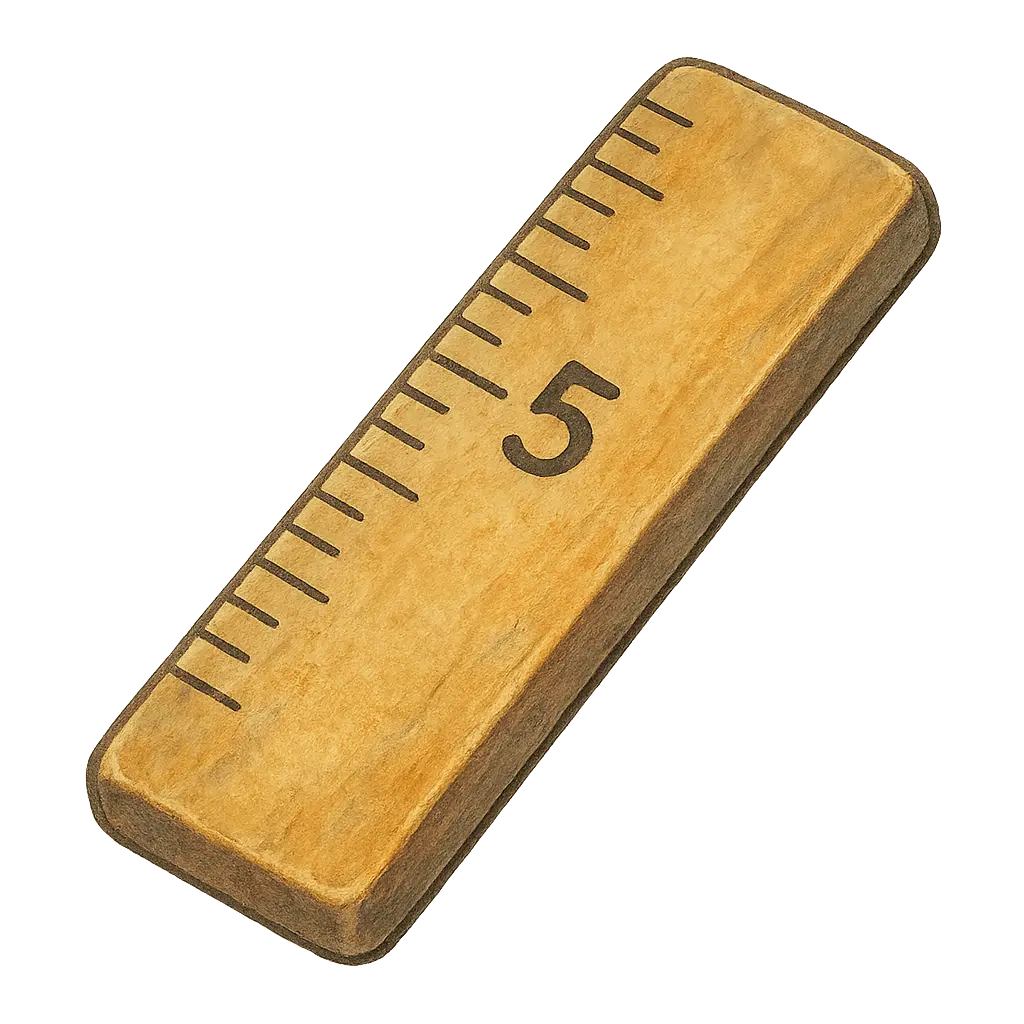
inch
From Thumb Joints to Satellites: A Brief History
Long before rulers were stamped with neat black graduations, carpenters and masons gauged small distances with the most convenient tool at hand—their own hands. One rough thumb width became the seed of the modern inch. Medieval English law later codified it more carefully, defining an inch as the length of three dry barleycorns laid end-to-end. That rustic image survived for centuries, until the age of precision engineering demanded something less botanical and more universal. In 1959, the United States, Canada, and the United Kingdom—together with several other nations still using Imperial measures—signed an agreement declaring the inch to be exactly 25.4 millimetres, or one thirty-sixth of a yard. That microscopic rounding-off (a few parts in a million) finally made the inch compatible with the metric system, ending countless headaches for draftsmen and machinists who straddled both worlds.
Everyday Workhorse of Science and Industry
Despite repeated predictions of its demise, the inch remains indispensable in dozens of technical arenas. Mechanical engineers still draft pipe threads and bearing journals in fractional inches. Civil engineers chart rainfall in inches because gauges marked “2.37 in” communicate storm totals more intuitively to homeowners than “60.2 mm.” In electronics, printed circuit board designers talk about “0.1-inch header spacing,” and the ubiquitous 2.5-inch laptop hard drive is dimensioned in, yes, inches. Even astronomers join the party—when they boast about a “14-inch Schmidt-Cassegrain telescope,” they’re referring to the diameter of the primary mirror.
How Big Is an Inch, Really?
If metric numbers feel abstract, picture these yardsticks of daily life:
• A standard credit card is almost exactly 0.03 in thick—stack 33 of them and you have an inch.
• The diameter of a U.S. quarter is 0.955 in, just a whisker shy of the full inch.
• A healthy newborn’s wrist circumference hovers around 4 in; an NBA player’s shoe might be 14 in long.
Such tangible references help our brains anchor the unit to reality.
Noteworthy Trivia
• The phrase “give ’em an inch and they’ll take a mile” unintentionally fuses Imperial and metric legacies; a literal mile is 63,360 inches.
• On early typewriters, the customary one-inch margin became the default page layout for word processors—a Victorian mechanical quirk that survives on 4K monitors.
• NASA’s Mars Climate Orbiter infamously crashed in 1999 because one engineering team used pound-seconds while another used newton-seconds; had the units been inches versus millimetres, the inch might have earned similar notoriety.
Why It Still Matters
The inch endures because it bridges old world craftsmanship and modern precision. It’s small enough to express finger-sized details, yet large enough to escape scientific notation. And with its exact metric definition, the inch now travels seamlessly between machine shops in Ohio and microchip fabs in Taiwan. Whether you’re hanging a picture frame, specifying a telescope mirror, or designing a robot chassis, that modest 25.4-millimetre stretch of space remains a remarkably handy slice of the length spectrum—proof that a medieval barleycorn can, with a little polishing, fit snugly inside the digital age.
meter
The Birth of a Benchmark
Picture revolutionary-era Paris in the 1790s: astronomers fanning out with sextants, hauling chains across fields, and peering through telescopes to measure a slice of Earth’s meridian from Dunkirk to Barcelona. Their ambitious goal was to distill the planet’s vastness into a single, democratic unit—one ten-millionth of the distance from the equator to the North Pole. That slice became the first mètre. Since then the definition has marched steadily toward ever greater precision—from platinum-iridium bars stored under glass bell-jars, to orange-glowing krypton-86 lasers, to today’s elegance: “the distance light travels in a vacuum in 1/299 792 458 of a second.” By anchoring the metre to the cosmic speed limit, scientists gave every laboratory on Earth an identical yardstick, limited only by the quality of its lasers and atomic clocks.
Why the Metre Matters
Because the metre sits at the root of the entire SI tree, every branch of science borrows its stability. Astronomers quote star distances in light-years, but those grand numbers resolve back to metres. Particle physicists chase quarks inside detectors only a few femtometres wide. Civil engineers pour concrete for bridges measured to the millimetre. Shrink a metre by a billion and you enter the nanotechnology playground where semiconductor channels are patterned only a dozen nanometres across—roughly 100 silicon atoms laid end to end.
Everyday Touchstones
• A guitar’s full length is roughly 1 m—handy when you need an impromptu spacing tool.
• A sprint down a 100 m track is the blink-and-you-miss-it race that crowns the world’s fastest humans.
• Look up: the wingspan of a Boeing 747 is just shy of 65 m, about two-thirds of a soccer field.
• Plunge beneath the waves: the blue whale, Earth’s largest animal, can eclipse 30 m from nose to tail.
Tricks for Mental Conversion
Visualize a three-foot toddler standing on a paperback book—that stack is almost exactly one metre. If you’re more comfortable with inches, remember 100 m is a football field plus end zones, while 1 km is a brisk ten-minute walk.
Curious Trivia
• The French meter bar of 1799 was accurate—by today’s standards—to about 0.2 mm. Modern labs now reproduce the metre within billionths of a millimetre.
• NASA’s Voyager spacecraft broadcasts telemetry calibrated in metres even as it coasts 24 billion kilometres from home; the signals merely stretch the unit across interstellar scales.
• In 1893 the United States legally adopted the metre as its fundamental reference, yet Americans still cling to the yard for day-to-day life—an enduring cultural tug-of-war.
The Takeaway
Whether you’re sketching kitchen cabinets, aligning mirrors in a laser cavity, or mapping the Milky Way, the metre silently underpins your measurements. It is at once an everyday companion and a cosmic constant—a remarkable testament to humanity’s quest to turn the universe’s vastness into something we can hold, calculate, and ultimately understand.